


Corporate Gift Sets: How to Create Memorable Branded Gifts for Clients and Employees
Corporate gifting is an effective way for businesses to recognize important relationships, celebrate achievements, and create positive experiences for employees and clients. A thoughtfully selected gift can communicate appreciation, strengthen professional connections, and make company interactions more memorable. Rather than choosing individual items without a clear theme, many organizations use coordinated gift packages to create a more polished and meaningful presentation.
Well-planned Corporate Gift Sets combine practical products, attractive packaging, and personalized details to reflect a company’s identity and the purpose of the occasion. They can be prepared for employee welcome programs, customer appreciation campaigns, business anniversaries, conferences, holiday celebrations, and other professional events. The most successful gift sets balance usefulness, quality, presentation, and relevance to the recipient.
Why Corporate Gift Sets Matter
Corporate gifts are more than a formality. They provide businesses with an opportunity to express appreciation in a tangible way. When selected carefully, a gift can help strengthen relationships and leave a positive impression long after an event or business interaction has ended.
A coordinated gift set also offers advantages over distributing unrelated promotional items. Matching products, consistent colors, and branded packaging create a unified presentation that feels intentional.
Some important benefits include:
- Relationship building: Thoughtful gifts can reinforce connections with clients, employees, and business partners.
- Employee recognition: Gift packages can acknowledge contributions, milestones, and achievements.
- Brand visibility: Logos and brand colors help recipients associate the gift with the organization.
- Professional presentation: Coordinated packaging creates a polished impression.
- Practical value: Useful products are more likely to become part of recipients’ everyday routines.
- Event consistency: Matching gift sets help create a unified experience at conferences, meetings, and corporate celebrations.
The value of corporate gifting comes from the thought behind the selection rather than the price of the items alone.
Choosing the Right Occasion for Corporate Gifts
Before selecting products, businesses should identify why they are giving the gifts. The occasion influences the contents, presentation, budget, and level of personalization.
Client Appreciation
Client gifts can recognize ongoing partnerships, celebrate successful projects, or thank customers for their continued support. Practical office accessories, premium stationery, drinkware, and carefully selected gift items are common options.
For important business relationships, presentation and product quality deserve particular attention. A simple but well-coordinated package may communicate appreciation more effectively than an expensive collection of unrelated products.
Employee Recognition
Employees may receive corporate gifts for work anniversaries, outstanding performance, promotions, team achievements, or annual celebrations.
Gift sets can include useful workplace products, notebooks, pens, drinkware, and personalized accessories. Including a handwritten note or recognition message can make the package feel more personal.
New Employee Welcome Kits
Welcome kits help introduce new employees to company culture and provide useful items for their first days at work.
A typical package might contain a branded notebook, pen, reusable bottle, identification accessories, and an employee information guide. Packaging can include the company’s logo and a welcoming message.
The goal should be to create a practical introduction rather than fill the package with unnecessary promotional merchandise.
Conferences and Corporate Events
Businesses often distribute gift sets at conferences, trade shows, training sessions, and networking events. These packages may contain stationery, event schedules, branded merchandise, and other useful materials.
The contents should reflect the event’s purpose and be easy to carry. Compact packaging is particularly important when attendees are traveling or moving between sessions.
Holidays and Company Anniversaries
Seasonal celebrations and company milestones provide opportunities to recognize employees, clients, and business partners. Gift sets can be designed around a specific theme while maintaining consistent branding.
For example, a year-end package might include stationery, a calendar, a drinkware item, and a personalized greeting card. A company anniversary gift could feature a commemorative product or a message highlighting the organization’s history.
Popular Items to Include in Corporate Gift Sets
The contents of a gift package should be selected according to the recipient’s needs, the occasion, and the available budget. A balanced set usually combines practical items with one or two distinctive additions.
Notebooks and Journals
Notebooks are useful in many professional environments. Employees can use them for meeting notes, planning, brainstorming, and daily tasks, while clients may appreciate them as practical desk accessories.
Businesses can customize notebook covers with logos, brand colors, company names, or event details. Different sizes, paper types, binding styles, and cover materials allow organizations to match the product to the intended audience.
Pens and Writing Accessories
Pens are a natural companion to notebooks and remain common corporate gift items. They are compact, easy to distribute, and suitable for many professional settings.
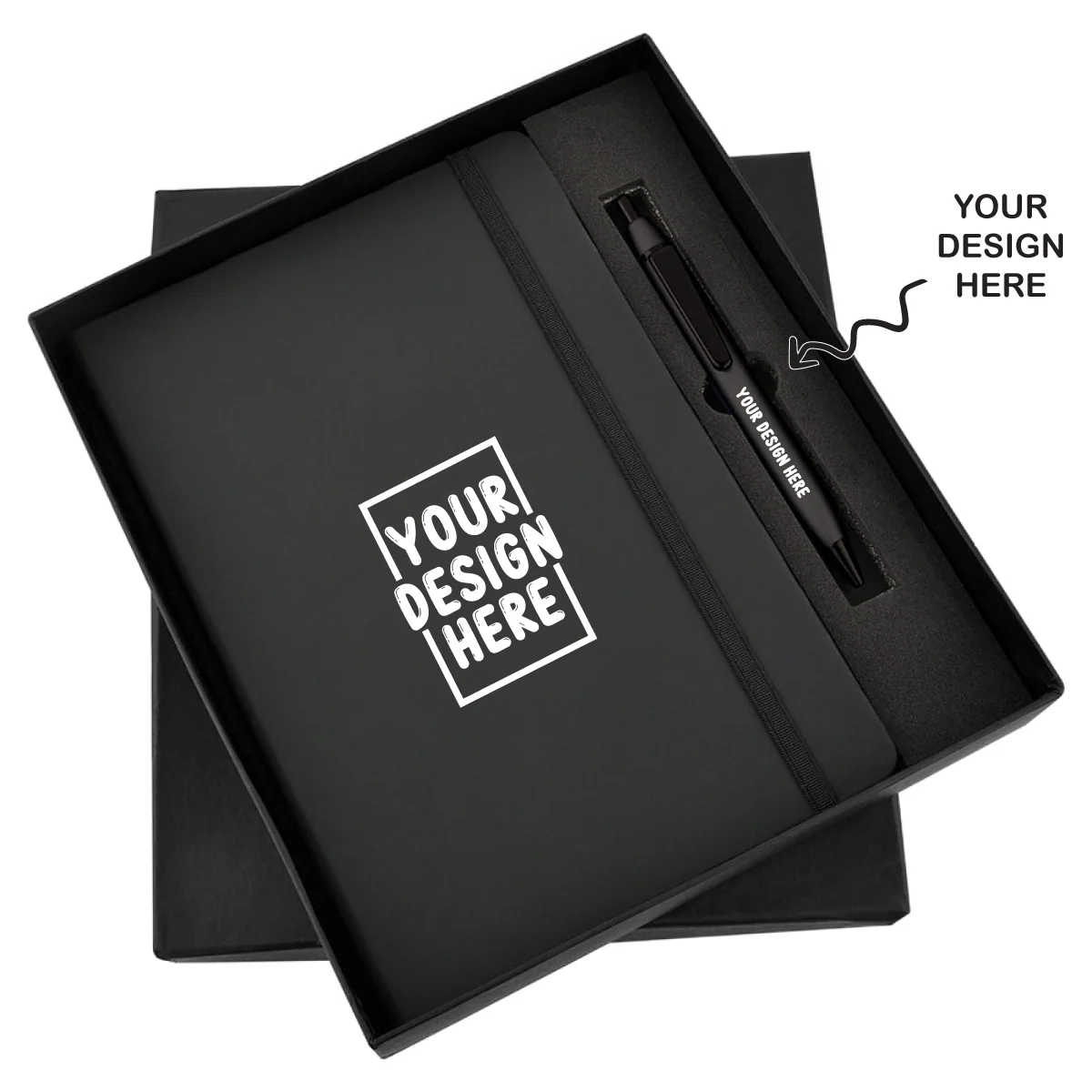
A notebook and pen combination creates a coordinated stationery gift. Businesses can select different pen finishes and styles depending on the desired presentation and budget.
Drinkware
Reusable bottles, travel mugs, and coffee cups can add everyday usefulness to a gift package. These products are especially suitable for employees who commute or work in different environments.
Before choosing drinkware, consider material quality, ease of cleaning, capacity, and whether the design is appropriate for the recipient.
Desk Accessories
Desk organizers, mouse pads, calendars, document holders, and other workspace products can be useful additions to employee and client gift sets.
These items are most effective when they address practical needs rather than simply carrying a company logo.
Technology Accessories
Technology-related products may suit organizations whose employees and clients regularly use digital devices. Depending on the budget, options can include cable organizers, laptop sleeves, phone stands, or compatible charging accessories.
Product compatibility and quality should be checked carefully before placing a bulk order.
Personalized Cards and Messages
A message card can make a corporate gift feel more thoughtful. It may include a thank-you note, welcome message, anniversary greeting, or recognition statement.
The wording should match the relationship and occasion. A message for a long-term client may be more formal than a welcome note for a new employee.
How to Create a Cohesive Gift Set
A memorable corporate gift set should feel like a coordinated collection rather than a random assortment of products. A clear theme helps guide the selection process.
Start with a Purpose
Define the objective before choosing the products. Is the gift intended to welcome a new employee, thank a client, recognize performance, or support a conference?
Once the purpose is clear, it becomes easier to identify suitable products and avoid unnecessary additions.
Understand the Recipient
Consider the recipient’s professional role, preferences, work environment, and likely use for the items. A package designed for office employees may differ from one intended for conference attendees or senior business partners.
For larger campaigns, businesses can use a common gift theme with a few optional variations to accommodate different groups.
Select a Practical Combination
Choose items that work well together. A notebook, pen, and desk accessory form a natural stationery set, while a reusable bottle, travel mug, and small organizer may suit a commuting professional.
The number of products matters less than their relevance and quality.
Maintain Consistent Branding
Use a coordinated color palette and consistent logo placement across the selected items and packaging. Branding should be visible without making the products feel like advertisements.
Some businesses choose subtle branding for premium gifts and more prominent logos for promotional event packages. The appropriate approach depends on the recipient and the purpose of the gift.
Add a Personal Detail
Personalization can make a standard package more meaningful. Depending on production capabilities and budget, businesses may include a recipient’s name, department, event date, or customized message.
Even a simple greeting card can make the presentation feel more considerate.
Packaging and Presentation Ideas
Packaging influences the first impression a recipient forms before opening a gift. A coordinated presentation can make ordinary products feel more organized and valuable.
Custom Gift Boxes
Gift boxes provide structure and help arrange several products neatly. They are suitable for premium client gifts, employee recognition packages, and company celebrations.
Internal inserts or dividers can keep products in place and prevent unnecessary movement during transportation.
Branded Paper Gift Bags
Paper gift bags offer a convenient alternative to boxes, particularly for conferences, retail events, and packages that recipients need to carry.
Businesses can customize them with logos, brand colors, and event information. Material thickness, dimensions, and handle strength should be selected according to the package’s weight.
Tissue Paper and Protective Inserts
Tissue paper can improve the presentation of products inside a box or bag. Custom inserts can also help organize the contents and protect delicate items.
These details are especially useful when a package includes several products with different shapes or sizes.
Sustainable Packaging Options
Organizations interested in reducing packaging waste can explore recycled paper, reusable containers, and appropriately sourced materials.
The choice should be based on verified material information and practical requirements. A package that is unnecessarily large or difficult to reuse may undermine its intended purpose.
Branding Strategies for Corporate Gift Sets
Branding helps connect the gift with the organization, but it should be applied thoughtfully. A professional package should feel like a genuine expression of appreciation rather than a collection of advertisements.
Use a Consistent Visual Identity
Apply the company’s established colors, typography, and logo consistently. This creates recognition across different products and packaging components.
Businesses should prepare artwork according to the supplier’s specifications to maintain accurate colors, proportions, and print quality.
Choose Suitable Customization Methods
Different products require different branding techniques. Common options include:
- Screen printing: Suitable for certain simple logos and designs.
- Digital printing: Useful for detailed graphics and selected short-run projects.
- Laser engraving: Often used for compatible metal or wooden accessories.
- Foil stamping: Adds decorative metallic details to suitable packaging or stationery.
- Embossing: Creates a raised design on compatible surfaces.
- Custom labels: Offer flexibility for packaging and selected products.
The best method depends on the product material, design complexity, order quantity, and desired appearance.
Avoid Excessive Branding
A logo does not need to appear prominently on every item. Repeated branding can make a gift feel more like promotional merchandise than a thoughtful present.
A balanced approach might feature the company logo on the packaging and one or two selected products, while keeping other items simple.
Setting a Realistic Corporate Gifting Budget
Budget planning helps businesses maintain quality while managing the cost of large gift campaigns. The total budget should account for more than the products themselves.
Important cost factors include:
- Individual product prices.
- Custom printing or engraving.
- Gift boxes, bags, and internal packaging.
- Design and artwork preparation.
- Assembly and packing labor.
- Shipping and distribution.
- Taxes and other applicable charges.
Businesses should compare complete quotations rather than choosing suppliers based only on the lowest item price.
For large orders, it may be useful to create different gift tiers. For example, employees might receive a standard welcome package, while long-term clients receive a more premium selection. Each tier should still maintain a consistent overall design.
Ordering Corporate Gift Sets in Bulk
Bulk purchasing can simplify distribution and help organizations maintain consistent presentation across teams or locations. It may also reduce per-unit costs, depending on the supplier’s pricing structure.
However, large orders require planning and coordination.
Confirm Quantities Early
Estimate how many recipients will receive gifts and allow for reasonable additional stock. For employee programs, consider new hires and possible replacements. For events, base quantities on expected attendance and distribution plans.
Request Product Samples
Samples help evaluate material quality, product functionality, printing accuracy, and packaging construction. They are particularly important when ordering several customized items together.
Approve Artwork and Specifications
Review logos, names, colors, dimensions, and printed messages before production. Check that all products use consistent branding and that any personalized information is accurate.
Establish a Delivery Schedule
Corporate gifts are often tied to specific dates, such as conferences, holidays, or company anniversaries. Confirm production and shipping timelines with the supplier and leave enough time for potential revisions.
Inspect Finished Products
Before distribution, check a representative selection of the completed gift sets. Look for damaged products, missing components, printing errors, and inconsistent packaging.
How to Choose a Reliable Corporate Gift Supplier
A dependable supplier can make the difference between a smooth gifting project and a difficult production process. Businesses should assess several factors before committing to an order.
Product range: Check whether the supplier offers suitable products, materials, and customization options.
Customization experience: Review previous examples to understand the quality of printing, engraving, packaging, and finishing.
Sample availability: Ask whether physical samples or proofs are available before bulk production.
Production capacity: Confirm that the supplier can handle the required quantity within the expected timeframe.
Transparent pricing: Request a detailed quotation that includes products, customization, packaging, and delivery.
Communication and support: Choose a supplier that provides clear specifications, responds to questions, and communicates potential delays.
A supplier should also be willing to discuss practical limitations rather than promising customization that may not be technically suitable.
Measuring the Effectiveness of Corporate Gifting
Businesses can evaluate gifting programs by considering whether the gifts achieved their intended purpose.
For client appreciation campaigns, useful indicators may include recipient feedback, relationship engagement, and responses to follow-up communication. For employee programs, organizations can gather feedback about product usefulness and the overall presentation.
Event organizers may assess attendee responses, distribution efficiency, and whether the gifts supported the event experience.
The goal is not to measure the value of a professional relationship through the price of a gift. Instead, feedback can help businesses make future selections more relevant and improve the overall gifting process.
Common Corporate Gifting Mistakes to Avoid
Several mistakes can reduce the impact of an otherwise well-planned gift program.
Selecting items without considering the audience: A product that is useful to one group may not suit another. Recipient needs should guide the selection.
Prioritizing quantity over quality: Too many inexpensive products can create clutter. A smaller collection of useful items often provides a better experience.
Using inconsistent branding: Different colors, logo sizes, and packaging styles can make the set look uncoordinated.
Ignoring practical packaging: Gift sets should be easy to open, carry, store, and distribute.
Leaving production too late: Customization and bulk assembly require time. Early planning helps avoid rushed decisions and delivery problems.
Overlooking personalization errors: Incorrect names, dates, or messages can undermine an otherwise professional presentation. Proofreading is essential.
Conclusion
Corporate gift sets offer businesses a practical way to recognize employees, appreciate clients, and strengthen professional relationships. Their effectiveness depends on selecting relevant products, maintaining consistent branding, and presenting everything in packaging that suits the occasion.
A successful gift set does not need to be complicated or expensive. Useful stationery, quality accessories, personalized messages, and coordinated packaging can create a memorable experience when chosen with care. By setting a clear purpose, understanding recipients, planning the budget, and working with a reliable supplier, organizations can develop corporate gifting programs that feel thoughtful, professional, and meaningful.