


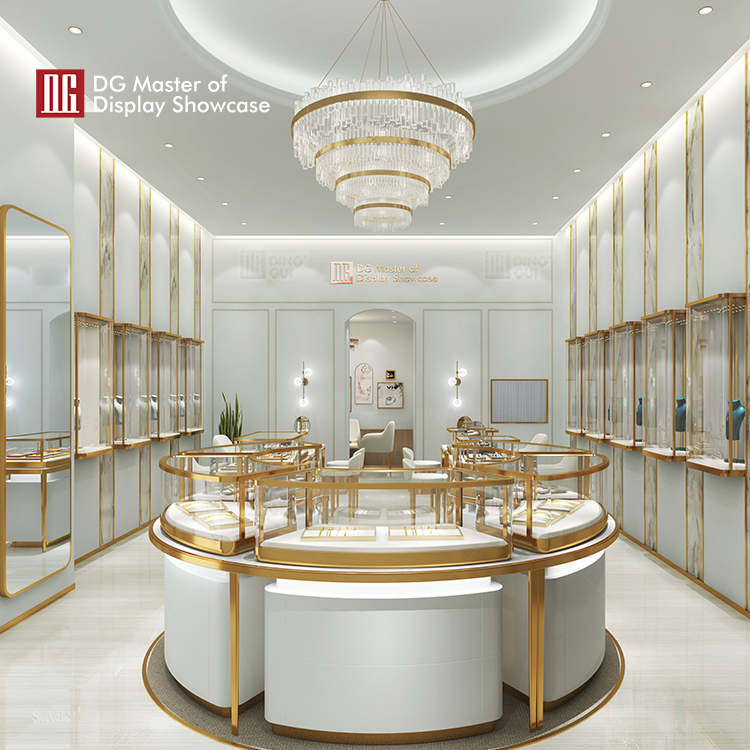
Custom Jewelry Showcases for Different Store Layouts and Spaces
Every jewelry store has a different physical environment. Some operate in compact boutiques with limited floor space, while others have spacious showrooms designed around multiple product categories. The layout influences how customers move through the store and how merchandise can be presented.
Custom Jewelry Showcases can be designed around these differences, allowing retailers to consider dimensions, viewing angles, storage, lighting, and security according to the available space. The objective is to make effective use of the store without creating unnecessary obstacles for customers or staff.
Showcases for Small Jewelry Stores
Compact stores require careful use of floor and wall space. Countertop cases and narrow wall-mounted showcases can provide product display areas without occupying large sections of the sales floor.
Vertical storage can also help make better use of limited space. Combining display areas with enclosed cabinets or drawers can provide additional storage without requiring separate furniture.
Long and Narrow Store Layouts
Long, narrow stores can benefit from showcases positioned along walls or arranged in linear configurations. This approach can create a clear customer pathway while keeping merchandise visible along the length of the store.
Wall-mounted displays may be particularly useful where floor depth is limited. Freestanding units should be positioned carefully to maintain sufficient aisle width.
Open-Plan Jewelry Showrooms
Larger open-plan stores offer more flexibility in showcase placement. Freestanding and island cases can be used to create dedicated zones for different collections.
The arrangement can guide customers through the space while allowing merchandise to be viewed from multiple directions. Different showcase heights can also create visual variation without disrupting the overall layout.
Corner Spaces
Corners are sometimes difficult to use effectively with standard furniture. Custom corner showcases can be shaped or sized to fit these areas while maintaining useful display capacity.
Corner units can also connect two display walls, creating a continuous merchandising area rather than leaving unused gaps.
Wall-Focused Displays
Stores with extensive wall space can use wall-mounted or built-in showcases to keep the central floor relatively open. This configuration may work well when customer circulation is a priority.
Built-in designs can be coordinated with surrounding wall panels, lighting, and architectural details to create a unified display system.
Central Island Displays
Central island showcases can become focal points within larger retail spaces. Because customers can approach them from several directions, they are suitable for collections that benefit from high visibility.
The dimensions should be carefully planned so that the case provides sufficient display capacity without making the surrounding space feel crowded.
Stores With Multiple Product Categories
Jewelry retailers may display rings, necklaces, earrings, bracelets, watches, and accessories within the same store. Each category can have different spatial and presentation requirements.
Custom interiors can incorporate different shelf heights, trays, holders, hooks, and compartments within a coordinated showcase design.
High-Traffic Retail Environments
Stores with significant customer traffic need layouts that allow people to move comfortably around displays. Showcase corners, door positions, and protruding components should be considered when planning the floor arrangement.
Durable materials and reliable hardware are also important when furniture will experience frequent daily use.
Premium Boutique Environments
Luxury-focused boutiques may prioritize spacious presentation and carefully controlled sightlines. Larger showcases with refined materials, integrated lighting, and carefully arranged interiors can support this type of environment.
The design should still provide practical access for sales staff and allow customers to examine products comfortably.
Flexible and Modular Spaces
Retailers that frequently change collections or store layouts may benefit from flexible showcase configurations. Modular units, adjustable shelves, and movable components can make future changes easier.
This can be useful for seasonal merchandising, promotional events, or businesses that regularly update their product mix.
Showcases Near Sales Counters
Counter areas often provide valuable opportunities for displaying smaller or higher-interest products. Compact showcases can be integrated into or positioned near the checkout and consultation area.
The design should provide clear visibility while allowing staff to access merchandise without interfering with customer transactions.
Planning Around Existing Fixtures
Custom showcases should account for elements that cannot easily be moved, such as columns, entrances, electrical outlets, counters, lighting fixtures, and security equipment.
Accurate measurements and a detailed floor plan can help manufacturers develop dimensions that fit the available space without requiring major changes to the store.
Lighting and Spatial Design
Lighting should be considered together with showcase placement. A display positioned beneath strong ambient lighting may require different illumination from one located in a darker section of the store.
Integrated LED systems can provide focused lighting while reducing the need for separate fixtures. Their placement should also account for wiring and maintenance access.
Security Within Different Layouts
Security requirements can vary depending on where a showcase is located. Displays positioned in open areas may need different access considerations from cases installed against walls or near staff-controlled spaces.
Possible features include secure locks, reinforced glass, concealed hardware, and lockable storage. The appropriate configuration depends on the merchandise and the retailer’s operating procedures.
Working With a Custom Showcase Supplier
Before manufacturing begins, retailers should provide accurate measurements, floor plans, photographs, and information about the merchandise to be displayed. These details help translate the available space into practical showcase dimensions.
DG Display Showcase can be assessed by discussing its available materials, customization capabilities, configurations, and installation requirements against the specific characteristics of the retail space.
A Simple Layout Planning Checklist
Before ordering custom showcases, consider:
- Available floor and wall dimensions
- Customer and staff circulation
- Entrance and exit locations
- Product categories
- Required display capacity
- Storage requirements
- Lighting conditions
- Security needs
- Existing fixtures and architectural features
- Future layout changes
These factors can help create a more efficient and visually consistent retail environment.
Final Thoughts
Custom jewelry showcases can be adapted to many different store layouts, from compact boutiques and narrow spaces to large open-plan showrooms. The key is to design around the physical characteristics of the store rather than trying to force a standard display into an unsuitable space.
By considering customer movement, merchandise requirements, storage, lighting, security, and future flexibility from the beginning, retailers can create showcase layouts that use available space effectively while maintaining a comfortable shopping environment.