


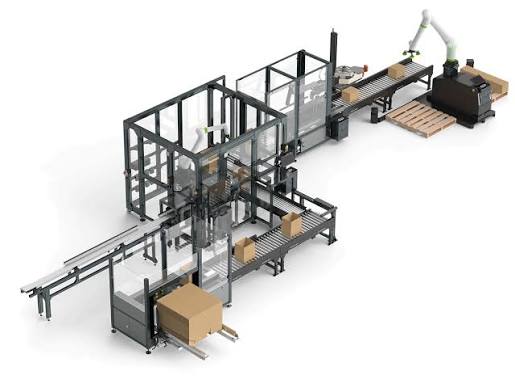
The Role of Robotics in Modern End of Line Packaging Automation
Modern manufacturing facilities are increasingly adopting robotic technologies to improve production speed, packaging accuracy, and workplace efficiency. As businesses handle larger product volumes and more demanding distribution requirements, traditional manual packaging methods can become difficult to maintain. Robotics offers manufacturers a flexible way to automate repetitive activities while creating more consistent workflows.
The integration of robotics into End of Line Packaging Automation allows businesses to streamline operations such as product picking, case packing, carton handling, palletizing, and package sorting. Robotic systems can work alongside conveyors, sensors, and automated control equipment to move finished products through different packaging stages. Understanding their applications and advantages helps manufacturers determine how robotic technology can improve their packaging operations.
Understanding Robotics in End-of-Line Packaging
Robotics in end-of-line packaging refers to the use of programmable robotic equipment to perform tasks involved in preparing finished products for storage and distribution.
Unlike conventional machines designed for a single repetitive operation, many robotic systems can be programmed to handle different movements and product arrangements. Their flexibility makes them suitable for manufacturing environments where product sizes, carton configurations, or packaging requirements may change.
Robots can be equipped with specialized gripping tools, suction devices, and other attachments to handle different products and packaging materials.
Depending on the production setup, robotic equipment may operate independently or as part of a fully integrated packaging line.
1. Automated Product Picking and Placement
Product picking is one of the important applications of robotics in packaging operations.
Robotic arms can pick individual products or groups of products from conveyors and position them in cartons, trays, or other packaging containers.
The gripping system depends on the product’s shape, weight, and surface characteristics. Vacuum suction tools may be suitable for certain packaged goods, while mechanical grippers can handle products requiring more secure support.
Robotic picking systems can also use sensors and vision technology to identify product positions before handling them.
This helps manufacturers reduce repetitive manual movements and maintain more organized product placement.
2. Robotic Case Packing
Robotic case packing involves loading products into shipping cartons using programmable robotic arms.
The system receives products from an upstream conveyor, identifies their positions, and places them into cartons according to a predefined arrangement.
This technology is useful for businesses handling different product sizes or packaging configurations.
For example, a robotic case packer may be programmed to arrange bottles, containers, or packaged consumer goods inside cartons according to specific patterns.
By automating the loading process, manufacturers can reduce manual handling and maintain consistent carton arrangements.
3. Robotic Palletizing
Palletizing is one of the most common applications of robotics in end-of-line packaging.
After products are packed and sealed into cartons, robotic palletizers arrange these cases onto pallets for storage and transportation.
A robotic palletizing system generally includes a robotic arm, product gripping equipment, a conveyor, pallet positioning arrangements, and control software.
The robot follows a programmed stacking pattern to place cartons in specific positions.
Different patterns can be used depending on carton dimensions, pallet size, product weight, and load stability requirements.
Robotic palletizers are particularly useful when manufacturers handle multiple products or need to change pallet configurations frequently.
4. Robotic Depalletizing
While palletizing organizes products onto pallets, depalletizing performs the reverse operation by removing products or cartons from existing pallet loads.
Robotic depalletizing systems can unload cartons, containers, and other packaged goods before they enter downstream production or distribution processes.
Some systems use machine vision to identify package positions and determine suitable gripping points.
This is particularly valuable in facilities that receive large quantities of packaged materials and need to transfer them into automated production workflows.
Robotic depalletizing can reduce repetitive lifting and help improve the consistency of material handling.
5. Machine Vision and Intelligent Object Recognition
Robotics becomes more flexible when combined with machine vision technology.
Vision systems use cameras and image-processing software to identify products, recognize their positions, and provide information to robotic controllers.
This capability is useful when products arrive on conveyors in different orientations or positions.
For example, a vision-guided robot may identify individual packages, determine their location, and select an appropriate gripping position.
Machine vision can also support inspection tasks, including label verification, package positioning, and identification checks.
The effectiveness of these systems depends on camera quality, lighting conditions, software configuration, and product consistency.
6. Collaborative Robots in Packaging Operations
Collaborative robots, commonly known as cobots, are designed to work in environments where human employees and robotic equipment may share certain work areas.
They can support selected packaging activities such as product placement, carton handling, labeling assistance, and lightweight palletizing.
Cobots may be suitable for businesses that want to automate specific repetitive tasks without installing a large industrial robotic system.
However, collaborative operation still requires a proper risk assessment, suitable safety features, and compliance with applicable machinery safety standards.
The choice between a collaborative robot and a conventional industrial robot depends on the task, operating speed, payload, workspace, and safety requirements.
7. Improved Packaging Speed and Productivity
Robotic systems can perform repetitive packaging tasks using programmed movements and controlled operating sequences.
This can help manufacturers maintain a steady production flow, particularly when handling large product volumes.
For example, robotic palletizers can continuously arrange cartons according to predefined patterns, while robotic case packers can load products without requiring employees to perform every placement manually.
The actual productivity improvement depends on the robot’s cycle time, payload capacity, product characteristics, and integration with surrounding equipment.
Manufacturers should evaluate the performance of the complete packaging line rather than relying only on the maximum speed advertised for an individual robot.
8. Greater Accuracy and Packaging Consistency
Consistent product placement and carton arrangement are important for protecting goods during transportation.
Manual handling can produce variations in product positioning, carton loading, and pallet stacking.
Robotic equipment follows programmed movement paths and placement instructions, helping reduce these variations.
For example, robotic palletizers can arrange cartons according to repeatable stacking patterns, while robotic case packers can position products in predefined configurations.
This helps businesses maintain more uniform packaging results and reduce certain types of handling errors.
9. Reduced Physical Workload for Employees
Packaging departments often involve repetitive activities such as lifting cartons, moving products, arranging cases, and stacking pallets.
These tasks can contribute to physical fatigue, particularly during long production shifts.
Robotics can take over selected repetitive or physically demanding operations.
Employees can then focus on machine supervision, packaging inspection, quality control, and equipment maintenance.
This approach can improve the allocation of human resources while reducing the need for employees to perform certain strenuous handling activities.
10. Flexible Handling of Different Products
Modern manufacturers often produce several product types with different dimensions, weights, and packaging requirements.
Robotic systems can support this variety through programmable movements and interchangeable gripping tools.
A robot may be configured to handle different carton sizes or product arrangements by selecting appropriate operating recipes.
However, flexibility depends on the robot’s payload, reach, gripping equipment, programming, and changeover procedures.
Manufacturers should evaluate the full range of products before selecting a robotic solution to ensure that the equipment can support their actual production needs.
11. Integration with Conveyors and Automated Packaging Equipment
Robots rarely operate alone in a modern packaging facility. They are usually connected with conveyors, case packers, carton sealers, inspection equipment, and other automated machines.
Conveyors transport products to the robotic workstation, while sensors provide information about product position and movement.
Programmable logic controllers coordinate equipment operations and manage communication between different stations.
For example, a robotic palletizer may receive sealed cartons from a conveyor, arrange them onto pallets, and signal the upstream system when the palletizing area is ready for the next load.
Proper integration helps reduce interruptions and maintain a coordinated production process.
12. Better Workplace Safety
Robotics can reduce employee exposure to certain repetitive lifting and material-handling activities.
However, robotic equipment also introduces potential hazards involving moving arms, gripping mechanisms, conveyors, and automated work zones.
Manufacturers must implement suitable safety measures, including:
- Physical guarding around restricted operating areas.
- Emergency stop systems.
- Safety interlocks.
- Light curtains and presence-sensing devices where appropriate.
- Clearly defined access and maintenance procedures.
- Operator training and risk assessments.
Safety requirements should be considered during system design, installation, commissioning, and daily operation.
13. Reduced Packaging Errors and Product Damage
Incorrect product placement, unstable carton arrangements, and inconsistent pallet stacking can increase the risk of packaging defects.
Robotic systems help control product movement and placement according to programmed instructions.
When combined with machine vision and inspection equipment, robots can also support more accurate product handling.
For instance, a vision system may identify a package’s position before a robotic arm picks it up, reducing the likelihood of incorrect gripping.
These technologies can help manufacturers improve handling consistency, although proper equipment setup and regular maintenance remain essential.
14. Long-Term Operational Benefits
Robotic packaging equipment requires an initial investment in machinery, integration, programming, and employee training.
However, businesses may gain long-term operational advantages through reduced repetitive labor, more consistent handling, improved production flow, and better use of available floor space.
A financial evaluation should consider the total cost of ownership rather than only the purchase price.
Important factors include:
- Robot and gripping equipment costs.
- Installation and system integration.
- Programming and commissioning.
- Energy consumption.
- Spare parts and maintenance.
- Operator and technician training.
- Expected production output.
A realistic investment analysis helps manufacturers determine whether robotic automation is suitable for their production environment.
Industries Using Robotic End-of-Line Packaging
Robotic packaging systems are used across different manufacturing sectors because they can handle a wide range of products and packaging formats.
Food and beverage: Robots can handle cartons, bottles, cans, and packaged food products during case packing and palletizing.
Pharmaceuticals: Robotic systems can support controlled product handling, case packing, and palletizing processes.
Cosmetics and personal care: Manufacturers use robotics to arrange packaged products and prepare shipping cartons.
Consumer goods: Robotic case packing and palletizing help manage large volumes of household products and retail packages.
Chemical manufacturing: Robots can handle selected containers, bags, and industrial packages when the equipment is appropriately designed for the application.
Each industry requires equipment configurations that match its product characteristics, safety requirements, and packaging standards.
Factors to Consider Before Implementing Robotic Packaging
Selecting the right robotic solution requires an understanding of the production environment and the tasks that need automation.
Manufacturers should evaluate several important factors:
- Payload capacity: Confirm that the robot can safely handle the weight of the product or carton, including the gripping equipment.
- Reach and workspace: Ensure that the robot can access the required picking and placement positions.
- Cycle time: Check whether the robot can meet the required production rate.
- Gripping technology: Select suitable tools according to product shape, weight, and surface characteristics.
- Product variety: Determine whether the robot can accommodate different sizes and packaging formats.
- System integration: Confirm compatibility with conveyors, sensors, controllers, and other packaging machinery.
- Maintenance support: Review servicing requirements, spare parts availability, and technical assistance.
- Safety requirements: Plan appropriate protective measures and operator training.
A detailed evaluation helps businesses avoid selecting equipment that cannot meet their actual operating requirements.
Conclusion
Robotics plays an increasingly important role in modern end-of-line packaging by automating repetitive tasks such as product picking, case packing, palletizing, and depalletizing. When combined with machine vision, conveyors, sensors, and automated control systems, robotic equipment can help manufacturers improve productivity, packaging consistency, workplace safety, and material handling.
Successful implementation requires careful planning, including payload evaluation, cycle-time analysis, equipment integration, and maintenance arrangements. Businesses should select robotic technologies according to their product requirements and production objectives rather than adopting automation without a clear operational purpose.
For manufacturers exploring integrated packaging solutions, Techflow Pack offers a relevant industry reference when evaluating equipment and technologies that can support more efficient end-of-line operations.